

Executive Summary (TL;DR)
PartnerStack is the enterprise heavy-hitter for B2B SaaS companies, but its premium price tag and revenue-share model shouldn’t be ignored by SMB founders. While its massive marketplace of 800,000+ partners is a major pull for companies with high ACV (Average Contract Value), smaller startups often find themselves priced out or overwhelmed by its complexity. In 2026, the decision to use PartnerStack comes down to a simple trade-off: do you need an all-in-one ecosystem with a built-in network, or do you need an agile, high-performance affiliate marketing platform like Tapfiliate?
- Best for Scaling Teams: If you are a Series B+ SaaS company with a dedicated partnership manager, PartnerStack is a power tool.
- The Price of Entry: Expect high monthly platform fees plus a percentage of your referral revenue, a cost structure that can punish bootstrap startups.
- Marketplace Power: Access to a pre-vetted network of SaaS-focused affiliates is PartnerStack’s “Killer Feature.”
- Agile Alternative: For founders who want control, direct S2S tracking, and predictable flat-fee pricing, Tapfiliate remains the superior choice for growth.
What is PartnerStack?
PartnerStack is a comprehensive partner management platform specifically engineered for B2B SaaS companies to manage affiliate, referral, and reseller programs in a single ecosystem. It is distinguished by its built-in marketplace of over 800,000 partners, automated commission payouts, and deep integrations with CRM tools like Salesforce and HubSpot. In 2026, it is widely considered an enterprise-grade solution for software brands looking to outsource partner recruitment and automated payout logistics at scale.
The SaaS Obsession: Why PartnerStack Only Does Software
I’ve noticed that PartnerStack’s greatest strength is also its greatest limitation: its extreme focus on SaaS. Unlike general-purpose tools, PartnerStack is built to handle the nuances of recurring revenue, subscription cancellations, and multi-tier reseller agreements. If you are selling a physical product or a one-time service, stay away—this platform isn’t for you. But if your business runs on MRR (Monthly Recurring Revenue), PartnerStack speaks your language.
However, being “SaaS-only” comes with a specialized price point. In my years of consulting for SMB founders, the most common complaint about PartnerStack isn’t the software—it’s the financial friction of getting started.
The Core Features: What You’re Actually Paying For
When you sign a contract with PartnerStack in 2026, you aren’t just buying tracking software; you are buying into an ecosystem.
1. The PartnerStack Marketplace
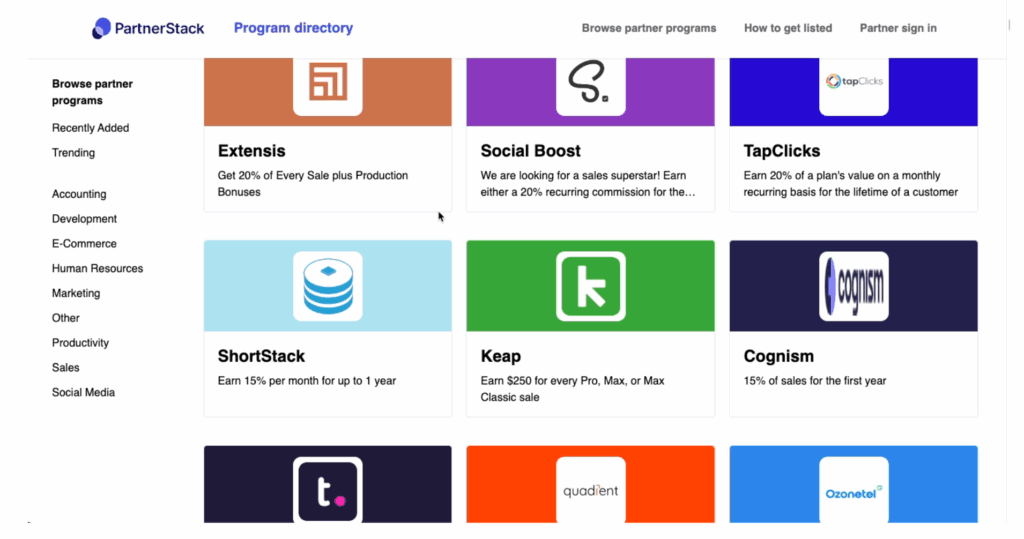
This is the platform’s “Golden Goose.” Imagine a directory filled with thousands of professional SaaS affiliates who are already familiar with the dashboard.
- The Rule: Instead of hunting for partners on LinkedIn, you list your program in the marketplace and let them apply to you.
While this sounds like a dream, remember that you are competing for attention with giants like Monday.com and HubSpot on the same page. If your commission isn’t top-tier, you might find your marketplace listing gathered digital dust.
2. Automated Payouts (The “Stripe for Partnerships”)
PartnerStack handles the complex world of global tax compliance and payments. They collect the W-9s, calculate the payouts, and send the money to your partners via PayPal or Stripe.
- The Answer First: PartnerStack’s payout system removes the administrative burden of partnership management, allowing brands to pay thousands of global partners with a single monthly invoice.
3. Deep CRM Workflows
If your sales team lives in Salesforce, PartnerStack is a natural extension. It can track when a lead is “Partner-Generated” and ensure the credit follows that lead through a 6-month sales cycle. This is critical for B2B reseller programs where the “Click” happens in January but the “Sale” happens in June.
The “Hidden” Reality: PartnerStack Pricing in 2026
We always tell marketers and founders to look at the “Effective Cost” of a platform, not just the sticker price. PartnerStack’s pricing is famously opaque, usually requiring a 20-minute demo to uncover, but the industry consensus for 2026 is clear.
High Base Fees + Revenue Share
PartnerStack typically charges a significant monthly subscription fee (often starting in the thousands) and takes a percentage cut of the commissions you pay out.
- The Bootstrap Trap: If you pay $10,000 in commissions per month, and PartnerStack takes a 15% override, you are paying $1,500 just in “tax” on your own success.
For many SMB founders, this revenue-share model is a dealbreaker. It makes your marketing costs variable and punishes you for scaling your program. In contrast, Tapfiliate’s flat-fee pricing allows you to keep 100% of your margins as you grow.
Tapfiliate vs. PartnerStack: Which One Wins in 2026?
I’ve helped brands migrate in both directions. Here is the honest breakdown of who should choose what.
| Feature | Tapfiliate (Agile/Power) | PartnerStack (Enterprise/Ecosystem) |
| Pricing Model | Flat Monthly Fee (Predictable) | Base Fee + Revenue Share (Variable) |
| Target Niche | E-commerce, SaaS, Services | Strictly B2B SaaS |
| Recruitment | Direct/Manual (High Control) | Marketplace-Driven (Hands-off) |
| Setup Speed | 15 Minutes (Self-Serve) | 4-8 Weeks (Managed Onboarding) |
| Tracking Tech | S2S, Postbacks, Cookies | Primarily Cookie/Pixel Based |
Why an SMB Might Prefer Tapfiliate
If you are a founder who values Agility and Data Ownership, Tapfiliate is the better fit. You don’t need a 2-month onboarding process to get a link tracked. You can integrate S2S tracking via a simple API call and have your first partner live by lunchtime.
Tapfiliate doesn’t take a “tax” on your commissions, which means more money stays in your product or goes back to your partners to keep them motivated.
The Onboarding Wall: PartnerStack’s Managed Experience
I always tell my clients that PartnerStack isn’t a “Sign Up and Start” platform. It is a “Managed Experience.” This can either be your favorite feature or your biggest frustration in 2026.
Is Onboarding an Asset or a Barrier?
When you sign an enterprise contract, you are assigned a dedicated implementation manager. They will help you map your HubSpot properties, set up your payment flows, and migrate your existing partners. This is often a 4-to-8 week process.
- The Pro: You don’t have to touch a line of code. They handle the “Heavy Lifting” for you.
- The Con: If you need to launch a referral wing for an upcoming product drop in 10 days, PartnerStack will tell you it’s impossible. You are bound to their implementation timeline.
For a Series B+ startup, this managed approach is a godsend. They have the budget and the patience for a slow, “Perfect” setup. But for an agile SMB or a bootstrap founder, this is a massive barrier to entry. I’ve seen teams lose significant seasonal momentum simply because they were stuck in the “Managed Onboarding” queue.
By contrast, Tapfiliate’s self-serve model is built for the “Now” economy. You can have your code integrated and your first link generated in under 15 minutes—not 8 weeks.
Advanced Feature Breakdown: Proration, Net-30, and Custom Invoicing
PartnerStack’s engineering team has spent years solving the specific accounting headaches of B2B SaaS. If your program involves complex payouts, these features might justify the fee.
Prorated Commissions
In the world of subscription software, customers upgrade and downgrade mid-cycle. PartnerStack can automatically prorate an affiliate’s commission based on their referral’s actual spend. If a referred customer upgrades from a $50/mo plan to a $500/mo plan, the affiliate’s cut automatically shifts.
Net-30 and Custom Invoicing
Large B2B brands often need to pay partners on “Net-30” or “Net-45” terms to align with their accounts payable department. PartnerStack allows you to build custom settlement windows. You pay one invoice to PartnerStack, and they distribute the funds across your entire global network, handling all the tax documents (like W-8BENs) in the process.
The Marketplace Dynamic
I’ve had founders ask me: “Once I’m in the marketplace, will I get hundreds of partners?”
The Answer First: No. You are one of thousands. Unless you are a top-tier brand with a high-convertible product, you still have to do the work of recruitment. The marketplace is a Lead Source, not a Sales Force.
Case Study: The “Revenue Share” Financial Trap
Let’s look at a hypothetical (but very common) 2026 scenario for a SaaS company scaling from $1M to $10M ARR.
The Setup: A B2B software brand has 200 high-performance affiliates generating $100,000 in monthly commissionable revenue.
| Platform | Fixed Monthly Fee | Revenue Share (15%) | Total Monthly Cost |
| PartnerStack | $1,500 | $15,000 | $16,500 |
| Tapfiliate | $499 | $0 | $499 |
The Result: Over a single year, that brand would pay an extra $192,012 simply to use PartnerStack. Is the marketplace and the managed onboarding worth a $192k annual tax?
In most cases, for an SMB founder, that money is better spent hiring a part-time partnership manager to do the recruitment work directly. By using a flat-fee system, you are essentially “buying back” your own margins.
Who is PartnerStack Actually For? (The ICP Scorecard)
I’ve created this “Ideal Customer Profile” scorecard. If you check fewer than 3 boxes, you are better off with an agile platform like Tapfiliate.
- High ACV ($5,000+): You sell enterprise software with high ticket prices.
- Series B+ Funding: You have a massive budget and aren’t worried about “Platform Tax.”
- Complex CRM Needs: You must have Salesforce-level lead-to-opportunity tracking.
- No In-House Team: You need to outsource the entire recruitment and payout process.
- Long Sales Cycle (6+ Months): You need sophisticated attribution across multi-touch journeys.
Beyond the Hype: The Hidden Disadvantages of PartnerStack in 2026
No platform is perfect, but when you are paying enterprise prices, you expect a level of flexibility that PartnerStack sometimes fails to deliver. Here are the “Grit in the Gears” I’ve found during 2026 technical audits.
1. The Middleman Payout Delay
Because PartnerStack handles the payouts, they receive your funds first and then distribute them to your partners. This adds an extra layer of “float” time. If your partner earns a commission on June 1st, they might not see that money in their bank account until August. For top-tier affiliates who run high-spend ad campaigns, this cash flow lag is a major irritant.
2. Rigid API Constraints
PartnerStack is built as a “Closed Loop” ecosystem. While they have an API, it is often structured around their specific workflows. If you have a custom-coded SaaS platform with a non-standard checkout flow, you may find that PartnerStack’s system is too rigid to map your data points accurately. You end up bending your business to fit their software, rather than the other way around.
3. The “Non-SaaS” Rejection
I’ve seen hybrid brands—companies that sell software and hardware—struggle on PartnerStack. Their marketplace is so heavily curated for pure-play SaaS that as soon as you introduce a physical product element, the recruitment engine stalls. If you aren’t 100% “Digital Subscription,” this is the wrong neighborhood for your brand.
Technical Deep-Dive: Why S2S Postbacks Beat Browser Pixels in 2026
As we navigate the final death of the third-party cookie, the way you track is more important than the platform you use. This is where the technical architecture of Tapfiliate’s S2S logic shines compared to enterprise legacy systems.
The Browser Pixel FailureTapfiliate’s S2S technical architecture
Most legacy platforms rely on “Browser Pixels”—a small piece of code that fires when a customer lands on a thank-you page. In 2026, Safari’s Intelligent Tracking Prevention (ITP) and heavy-duty ad blockers kill these pixels 30% of the time. This means 3 out of 10 sales go unrecorded. Your partners lose money, they get frustrated, and they leave your program.
The S2S (Server-to-Server) Solution
By using S2S postbacks, the tracking happens in the background. When a customer pays, your server pings the Tapfiliate API directly.
- Zero Data Loss: It cannot be blocked by the browser.
- Higher Truth: It only fires when the money is actually in your bank.
- Privacy First: It doesn’t require “stalking” the user across the web, making it fully GDPR/CCPA compliant.
For a technical founder, the choice between “Hoping a pixel fires” and “Knowing the server pinged” is an easy one.
The ROI of Direct Partnerships: Why Control Matters More Than Marketplaces
The biggest selling point of PartnerStack is the marketplace. But I want to challenge the idea that “Marketplace = Growth.”
The Dilution of Brand Loyalty
When an affiliate finds you via a marketplace, their loyalty is to the platform, not to you. They are likely promoting 10 other competing SaaS tools at the same time. You are just a line item in their dashboard.
The Power of the Direct Invitation
When you use a platform like Tapfiliate, you build a direct bridge to your partners. You invite your own power users, your own loyal customers, and your own industry peers to join your specific growth story. This creates a “Moat of Loyalty” that a generic marketplace partner can never replicate.
Furthermore, by saving the 15% revenue share fee, you can afford to pay your partners 20% higher commissions than your competitors who are stuck on high-tax platforms. In the affiliate world, “More Money for the Partner” is the ultimate recruitment tool.
Frequently Asked Questions (PAA)
Is PartnerStack worth it for small startups?
PartnerStack is generally not recommended for early-stage startups with a limited budget. Its high base fees and revenue-sharing model can create a significant financial burden before the program has proven its ROI. Most startups find better value in a flat-fee platform like Tapfiliate until they reach the Series B stage.
How does PartnerStack compare to other affiliate software?
Compared to general tools, PartnerStack offers superior B2B SaaS features like CRM integrations and a specialized marketplace. However, it lacks the flexibility and affordability of agile platforms. For brands selling physical goods or services outside of software, general-purpose platforms are more effective and easier to manage.
PartnerStack vs Tapfiliate: Which is better?
PartnerStack is better for large enterprise SaaS brands that need a built-in partner marketplace and automated global payouts. Tapfiliate is superior for SMBs and growing SaaS brands that want a predictable flat-fee structure, technical control through S2S tracking, and the ability to manage affiliate and referral programs on their own terms.
Final Thoughts: Look Beyond the Marketplace Shine
PartnerStack is a phenomenal product for a very specific type of company. If you have a huge budget, a dedicated partnership team, and a high-ticket B2B SaaS product, the marketplace access alone can justify the cost.
But don’t let the “Enterprise” branding blind you. For 90% of SMB founders in 2026, the goal is to build a lean, high-margin growth engine. You want to own your partner relationships, not rent them from a marketplace. You want to pay for a tool, not a “partner tax.”
If you’re ready to build a program that scales with your ambition—not your expenses—I recommend starting with a platform that values your margins as much as you do.
Looking Ahead: Partnerships in 2027 and Beyond
As we peer into the next decade of digital marketing, the model for software growth is shifting from “Acquisition at all costs” to “Retention via multi-variable partnerships.” We are seeing the rise of Dynamic Smart Contracts that automatically trigger global payouts based on the lifetime value (LTV) of the customer, not just the initial click.
In this near future, your affiliate program isn’t just a separate wing of your marketing; it’s an integrated engine that feeds directly into your product-led growth. By choosing a high-performance tracking system today, you are laying the foundation for this wave of the community-led economy.
Trust, transparency, and deterministic data (like S2S) are the only bridges to that future. Whether you choose the enterprise ecosystem of PartnerStack or the agile power of Tapfiliate, the critical decision is to start building your own network now. The brands that own their partner data today will be the ones that own the market in 2030.
Looking for an alternative to PartnerStack? Check out our alternatives page.
Source Bibliography
- G2 Software Review (2026): “PartnerStack vs the Field: A User Sentiment Analysis.” G2.com
- Efficient App Tech Audit: “The True Financial Burden of Enterprise Partner Management Software.” EfficientApp
- Tapfiliate Case Study Database: “Why SaaS Brands Move from Revenue Share to Flat Fee Models.” Tapfiliate
- SaaS Alliance Growth Report (2025): “Recruitment Strategies for B2B Software Startups.” SaaSAlliance
- Affiliate Insider Audit: “The Future of B2B Partner Ecosystems in the AI Era.” AffiliateInsider
- GrowSurf Trends Report (2026): “Word-of-Mouth Marketing and the Cookie Apocalypse.” GrowSurf
- SaaS Metrics Database: “Comparing CAC across Direct and Indirect Channels.” ChartMogul
- GDPR Compliance for Enterprise SaaS: “Safe Data Handling in Global Partner Payouts.” GDPR.edu




Comments